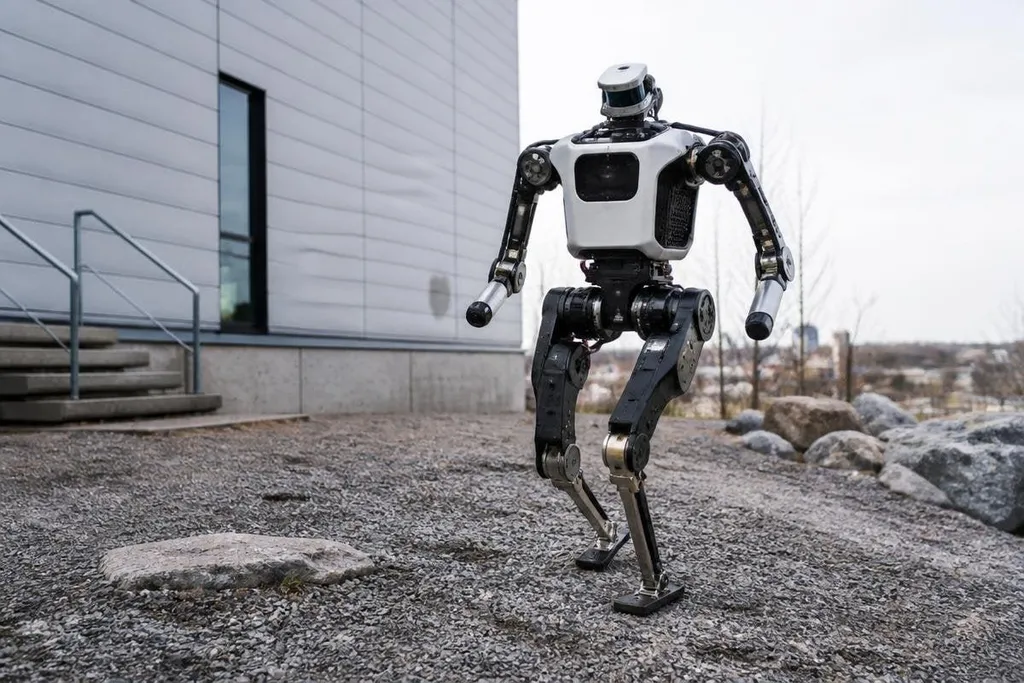
A walking robot stays upright by correcting small errors before they become a fall. It reads its body position, measures movement, and shifts force through its feet or wheels many times each second.
For anyone comparing autonomous systems, balance is a useful test of real engineering. A robot that looks steady in a staged video may still struggle with loose ground, a moving load, or a small push.
Quick read
- Balance starts with sensors that measure angle, speed, contact, and force.
- The controller changes motor torque before the body moves too far.
- Good results on a flat floor do not prove safe walking on rough ground.
How a robot knows it is tipping
To stay upright, the robot needs a constant estimate of its body position. An inertial measurement unit, or IMU, measures acceleration and rotation. The IMU contains tiny motion sensors that report how the body tilts and turns.
That estimate becomes more useful when the robot combines it with other sensor data. Joint encoders report the angle of each motor shaft. Foot pressure sensors can show whether a foot has touched the ground, while cameras or LiDAR can map obstacles and changes in the floor.
Each sensor has a weakness. An IMU can drift over time, and a camera can lose useful data in poor light.
A foot sensor may report contact without showing whether the ground will hold the robot's weight. The control system compares these inputs and builds one working estimate of the robot's state.
This process is called sensor fusion. It does not wait for one perfect reading. Several imperfect readings work together, and the estimate updates as new data arrives.
The control loop keeps the body upright
A balance controller compares the robot's current state with the position it wants. If the body leans too far to one side, the controller asks the legs to change their position or the motors to change their torque, which is the turning force at a joint.
The loop repeats quickly. Sensors report a change, software calculates a response, and motor drives send power to the joints. A delay at any point gives the body more time to move before the correction begins.
Many walking robots use a model of their body, joints, and contact with the ground. The model helps predict how a foot movement will affect the rest of the robot. The controller can then place a foot under the body, widen the stance, or change the next step.
That is why balance involves more than holding the torso upright. The robot must manage its center of mass, the point where its weight appears to act, inside a safe area made by its feet. A wider stance gives it more space for error, while a narrow stance demands faster corrections.
Feet, wheels, and contact make the difference
A robot can remain upright in several ways. A wheeled platform may steer or speed up to keep its center of mass over the wheel contact area. A legged robot has more choices, but each step creates a short period when some feet are off the ground.
The foot must reach a planned location, then confirm contact. If the floor is lower than expected, the leg needs to move farther. If the foot slips, the controller has to detect that change and alter the next motion.
This is where a clean laboratory floor can hide a weak design. Rubber mats, loose gravel, ramps, and wet surfaces change the forces at the contact point. A payload can change the center of mass too, so a robot that balances without a load may need a different gait with one.
A balance claim needs a named robot, test surface, payload, and recovery result behind it. Robot24.com robotics reporting can help you compare those details before the checks below.
What to check before trusting a balance claim
A product page rarely tells you enough on its own. Use this checklist when reviewing a robot for work near people, shelves, vehicles, or uneven floors:
- Sensor list: Check for an IMU, joint encoders, and contact or force sensing.
- Ground tests: Look for results on ramps, loose material, wet flooring, or thresholds.
- Load details: Check whether the stated balance result includes the planned payload.
- Recovery behavior: Watch for a clear response after a push, slip, or missed foothold.
- Control limits: Ask how the robot stops when its estimate becomes unreliable.
I'd trust a balance claim only after the maker shows the floor, the load, the full test, and the robot's recovery when conditions change.
The next useful evidence is not another slow-motion clip. It is a repeatable test that reports the surface, payload, sensor setup, recovery time, and number of failed steps.